2000 Staffers Have Left the Department of Justice US Attorney Offices Since September 2024

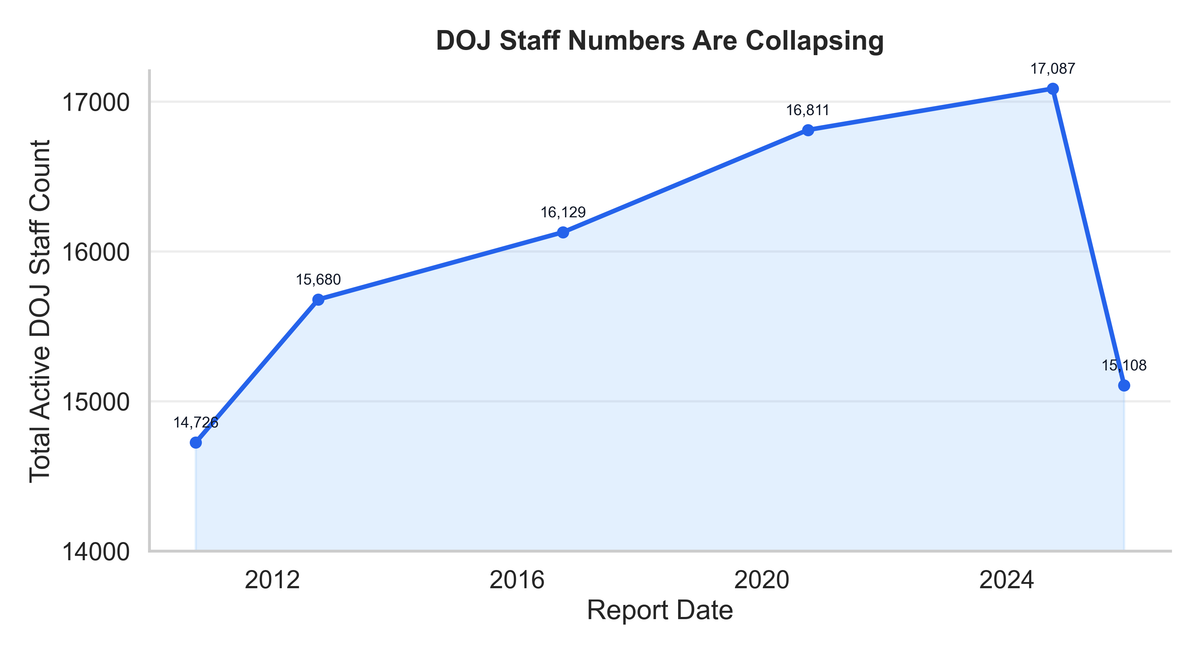
DOJ’s EOUSA workforce shrunk by more than 11.5% from 2024-2025.
Last week, a Department of Justice (DOJ) lawyer named Julia Le had a meltdown in court, telling a judge “The system sucks, my job sucks.” She went on to ask the judge to hold her in contempt so that she could get some sleep, further explaining that government lawyers simply cannot keep up with the caseload they have assumed. The Trump administration removed her from her position shortly thereafter.
Le’s plight underscores a growing crisis at DOJ. Many hundreds of attorneys have resigned or been fired since the beginning of Trump’s term, resulting in overworked lawyers busy with dozens of immigration cases per person. An analysis of publicly-available data shows that DOJ's EOUSA office, which includes the US Attorneys who prosecute federal crimes, is down more than 2000 workers since September of 2024, amounting to more than 10 percent of its workforce. The staffing shortage, coupled to the major increase in immigration case workload, could result in lawyers unable to keep up with DOJ’s traditional priorities: significant criminal investigations, national security, and civil rights, among others.
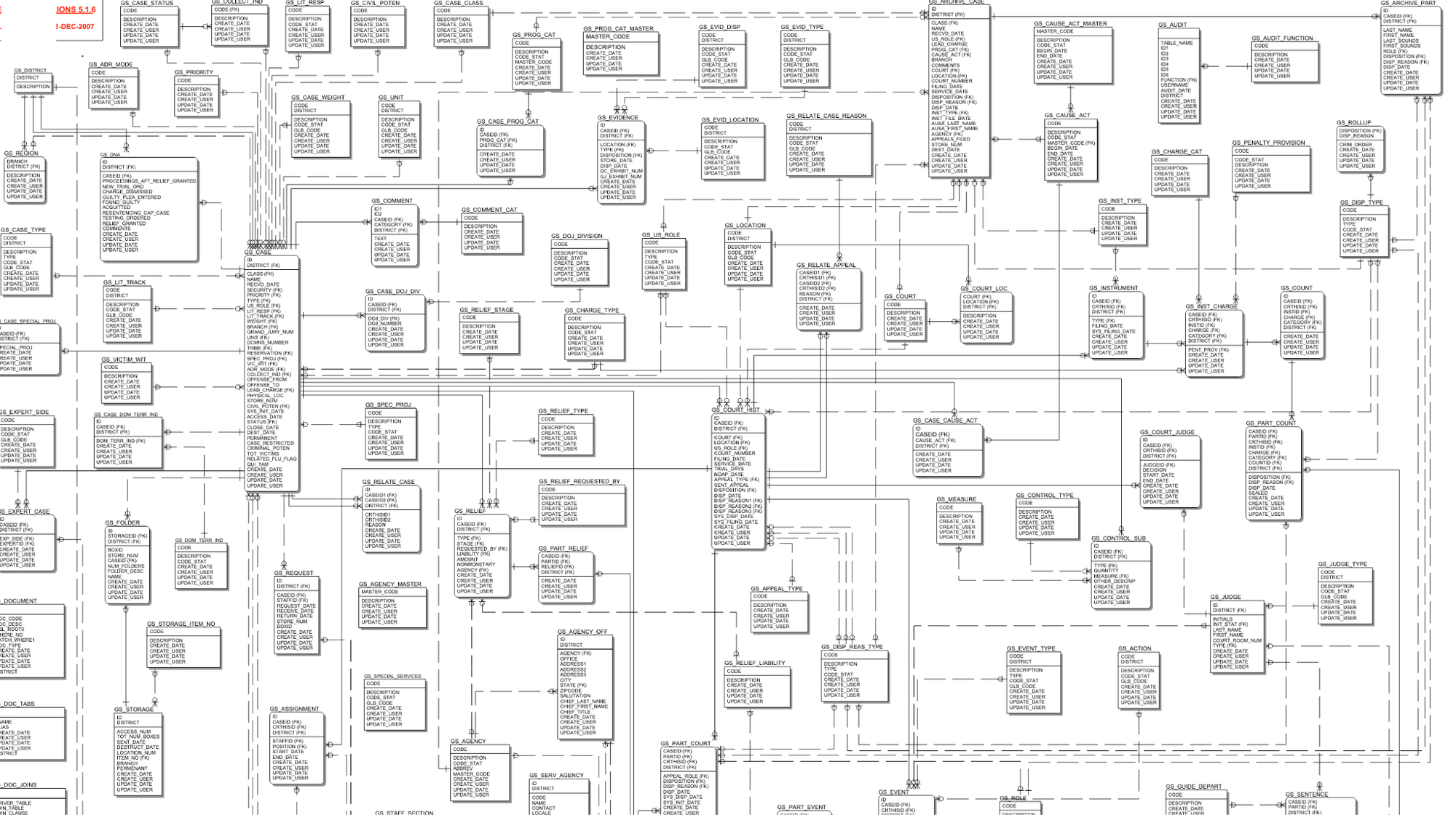
DOJ publishes a dataset called National Caseload Data which incorporates hundreds of different kinds of information about their activities, from employees to their assignments to the status of each individual case that they pursue and every filing within each case. (Some records are redacted, of course.) This dataset is extremely complicated, separated into (as of the latest release in November 2025) 28 different folders and hundreds of files, each with its own relationships to other files, data dictionaries, caveats, and issues. It’s a mess, albeit a well-documented mess (see the following image for a sample of the complexity in this dataset).
Fortunately, there’s a file listing all of the employees at DOJ's EOUSA office which is not nearly so inscrutable, so I started there. As of November of 2025, there were 15,160 active staff records in the data. Here's an important caveat: I wasn’t able to find a definition of what constitutes active staff in the data, but Julia Le’s name isn’t present, suggesting this directory doesn’t contain contractors like her.
By looking back at previous releases of the data, we are able to see how many active staff at the end of each fiscal year since 20101. Locating the correct files in the morass of records provided each year was laborious, so I only calculated the number of active staff periodically. The trend is clearly upward prior to 2025.
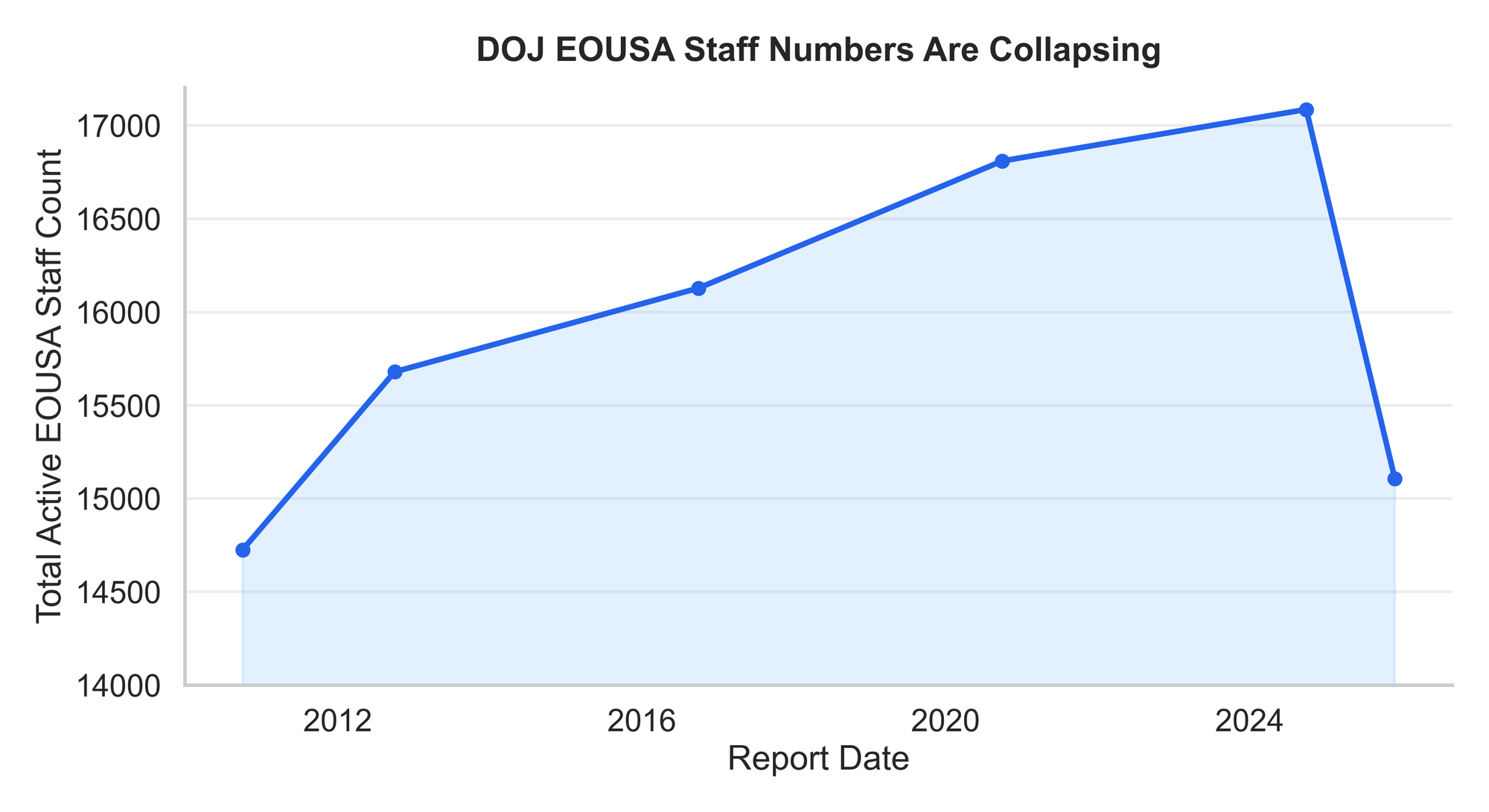
The fiscal year data as of 2024 shows that there were more than 17,000 workers at that time, or almost 2000 more than are currently employed. It’s important to note that this data is about three months out of date, so the actual count of employees is likely lower now, considering that journalists have reported on other mass resignations since November (notably in Minneapolis).
This appears to be the lowest total number of US Attorney staff since 2010. In 2010, the United States had almost 30 million fewer people living in it, so on a per capita basis, there are actually fewer employees than in 2010. There were 48 DOJ US Attorney staff per million US people in 2010, down to 44 per million in 2025.
About half the departures, roughly 1000 people, are assistant US attorneys themselves, or the typical line prosecutors for the government who do most legal work–filing briefs, representing the government before judges, and so on. Other support positions have shed substantial numbers as well, however, from paralegals to investigators, and almost no position has gained employees.
Losses vary by district as well. The drops are most significant mostly in large metro offices like those in Miami, DC, Chicago, and Minneapolis. The largest proportional decline has occurred in Oklahoma’s eastern district, where almost two-thirds of staff have left. A few districts have seen very small declines or minor gains, such as East Texas and Connecticut.
It’s possible that the government has counteracted some of the decline in employees by hiring contractors like Le. However, her extreme workload–reportedly, 88 cases in one month–suggests that efforts to offset the loss of full-time DOJ staff with contractors have not been successful, at least in terms of maintaining a manageable pace of work for individual lawyers.
Additionally, NPR (among others) reports that the loss of staff in many of these district attorney’s offices is having dramatic consequences on the ability of attorneys there to pursue even mundane cases. The reduction in DOJ’s US Attorney active staff corresponds with a massive influx of immigration cases, leading to increased immigration workloads while attorneys have relatively little time for the more serious crimes and civil cases they have traditionally pursued.
In the next post in this series2, I’ll investigate the effects this loss of staff at DOJ is having on their ability to turn around the cases which once formed (arguably) the most important part of their activities: serious fraud, large-scale prosecutions of criminal organizations, civil rights enforcement, and the like.
Edit (2/26/2026): Updated to clarify that the stats pertain to DOJ's EOUSA office. DOJ as a whole--including the FBI, DEA, and other agencies--has lost more like 6,000 employees.
1 Technically there are records back to 2005, however the file format seems to have changed significantly before 2010 and I cannot find the necessary documentation to produce a clean count before that year.
2 I am waiting on more months of data in the National Caseload Data series to get a better grip on the exact effects the loss of US Attorneys is having.