Most People Like the Same Movies--Except Trolls

“My tastes are simple: I am easily satisfied with the best.”
-Winston Churchill
Most people like to believe that they have their own special, unique taste, whether that be for movies, clothing, or music. The movies or art we especially like becomes part of our personality, our story for who we are. It’s confusing, then, that when data scientists go to construct algorithms to recommend movies to people, one of the most consistent findings is that taste is a lot less personal than we might think. In other words, with the exception of a certain class of trolls, most people like the same movies, and those movies are simply the best movies.
Let’s test this idea. I have two data sources to do so: the first is MovieLens, a large study out of the University of Minnesota with millions of reviews on thousands of movies. The second is from the Movie Database (TMDB), a free and open alternative to IMDb that makes their data available via API. Both contain millions of ratings of tens of thousands of movies, two huge samples.
The two sources have slightly different scoring systems: MovieLens uses the classic 5 star movie rating scale, while TMDB uses a 10 point scale from 1 to 10. For ease of use, I translated both to the 10 point scale by multiplying all MovieLens ratings by 2.
The overall distribution of movie ratings looks like the following.
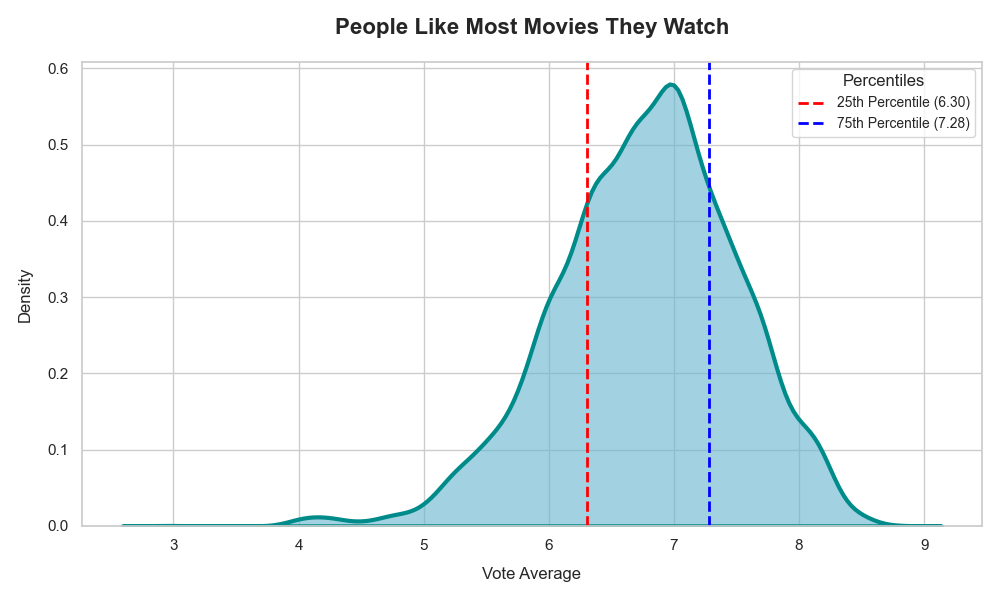
The most common score is 7, and most movies land in the range from about 6-7.5.
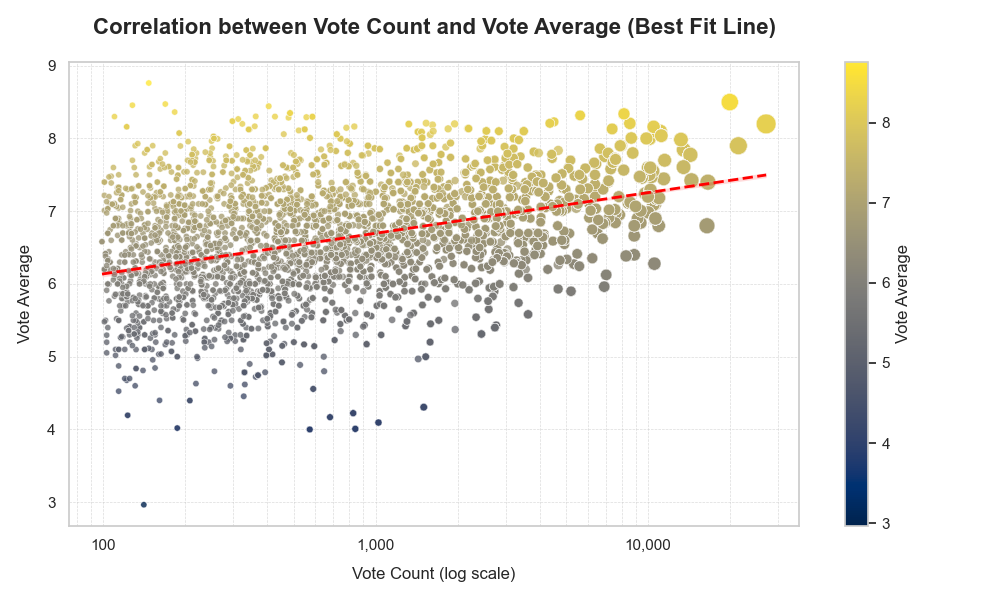
Further reinforcing the idea that people mostly like movies they watch (and watch movies they like) is the correlation between movie quality and number of votes. Most movies with lots and lots of reviews are also rated highly; some movies with very few reviews are also rated highly, but on average, they tend to be worse. Notably, you never see a movie with many, many reviews that is also very bad. This introduces an obvious selection bias in the data: we have much more data on good movies than bad. (On top of the selection bias incurred from the sample of people who want to provide movie reviews to begin with.)
By taking the average rating for each movie and then subtracting each individual reviewer’s rating from that average, we can calculate their level of disagreement with the consensus for each movie. This is the disagreement between each rating and the overall average for the movie in question.
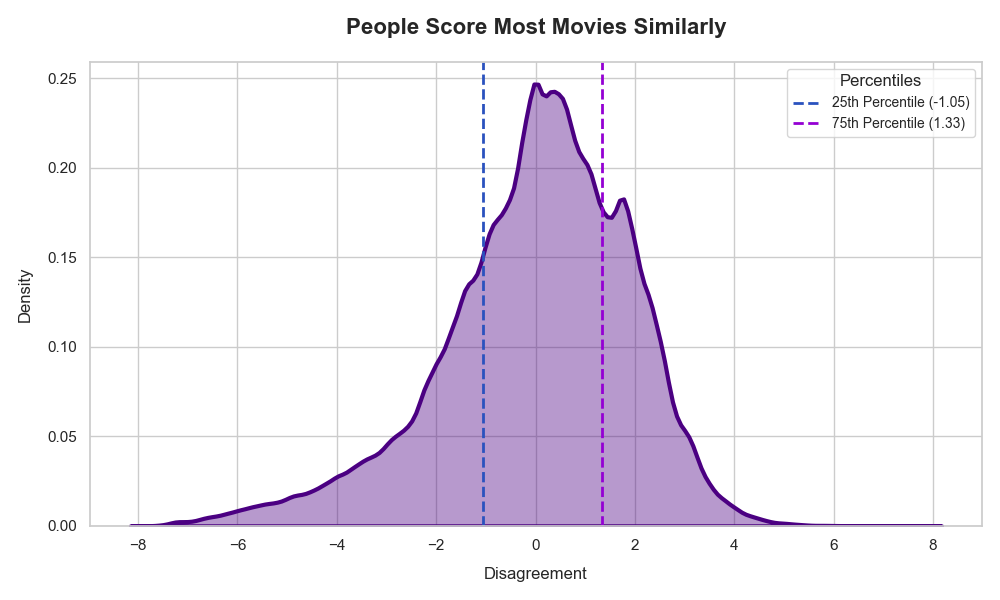
What’s striking is how little disagreement there is. More than half of all ratings are within 1 point (or half a star) of the average rating of a movie. Less than a quarter of ratings are more than 2 stars off of its average. If two people watch a clunker, both are liable to think it’s bad; at most, one person might think it’s “poor” and another “terrible,” but the differences in taste are modest.
Initially I thought this might be a result of herding–the idea that people adjust their ratings to conform to what others think. I looked for some evidence of this by examining the distribution of ratings over time. But I didn’t see any strong trend here; people are just as likely to score a movie similarly when it just came out as they are a year or two or more afterwards. Evidently, people agree just as much on movie ratings when it just came out and there is little consensus as when it is older and established.
There’s an interesting asymmetry to this data that’s persistent in both charts as well: More users disagree negatively with a movie’s rating than disagree positively. In other words, more people will watch a great, all-time classic and think it’s actually terrible than will watch a terrible piece of schlock and think it’s an all-time classic. This makes sense if you accept the idea that users preferentially want to watch good movies. If established 1-star flops are less likely to get reviewed to begin with, they are also less likely to get 5 star ratings from that one guy that thinks that Cats is the Best Movie Ever.
Revenge of the Trolls
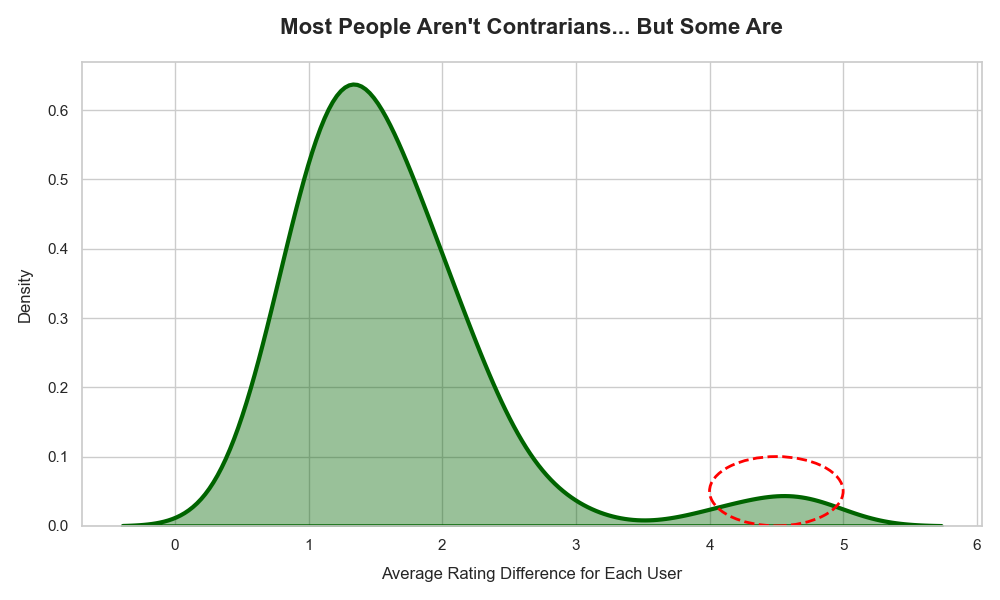
Now with all of that said, there is one group in the data with very distinct tastes, and it’s worth highlighting them for a lesson into the psychology of contrarianism. If you take the disagreement from the typical rating for each movie in the TMDb data and then average that disagreement over each individual reviewer, you get the following interesting distribution.
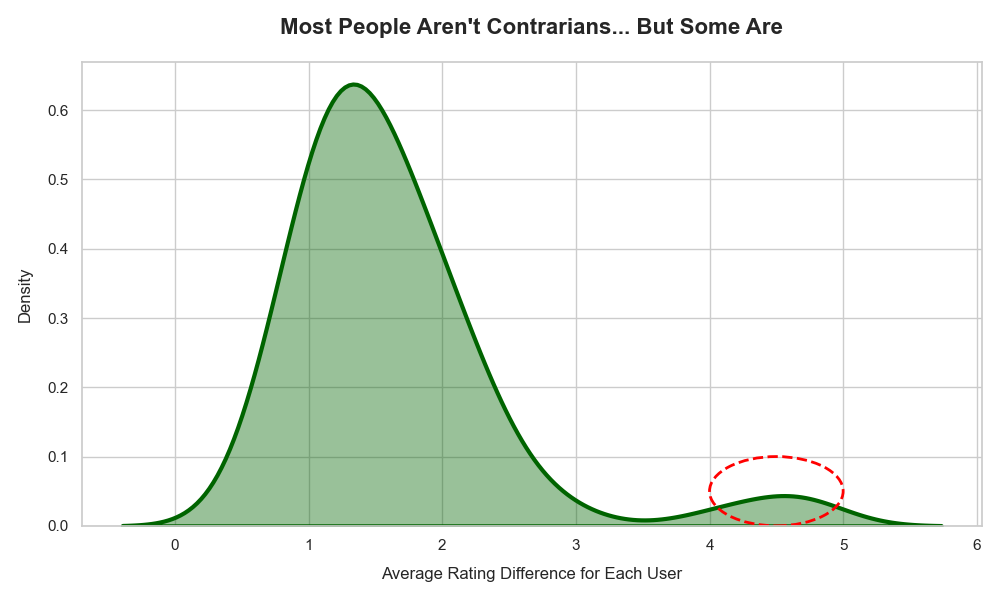
Most reviewers are clustered around the midpoint in the data above–they rate movies an average of about half a star away from their average rating. But there are a small group of reviewers, far to the right on the above graph, who consistently rate movies more than two full stars differently from the other reviewers. There are few reviewers in between these two sets, which suggests that the latter group is scoring films in a significantly different way.
So who are these raging contrarians? Trolls; specifically, political trolls. Having read some of their reviews, they are the types to call out movies with majority Black casts for “reverse racism.” They use the term "woke" more than 3.5x as often as the broader pool of movie reviewers. Their opinions are irrelevant, but it is interesting to think about the psychology of this kind of person. Their reviews are less an honest assessment of the quality of a movie and more of a performance of their political views.
This idea is reinforced by the fact that these trolls simply do not exist in the MovieLens data. Here, the distribution is unimodal, with no contrarians to be found. I don’t have the means to say with certainty, but I suspect that part of the reason is that MovieLens data is 1) anonymized and 2) not as prominently posted on the internet for others to see. If we think of the trolls as wanting to perform their dislike for Jordan Peele movies for an audience, then they can get that with the much more visible TMDB reviews, but less so with the MovieLens reviews.
Trolls aside, the consistent message here is that peoples’ tastes are more limited than I would have guessed. Churchill was more right than he suspected. Not only was he easily satisfied with the best–so are we all. Generally speaking, if other people like a movie a lot, you will too–perhaps a bit less than others, but you won’t hate it. That is, unless you’re a contrarian troll with a political axe to grind on a popular movie ratings website.