Bias Against Actresses Over 40 Can’t Be Explained Away

There are countless examples–from Geena Davis to Naomi Watts to Meryl Streep–of actresses being told their careers would be over when they turned 40. Despite some anecdotes about changing industry norms, there is still a strong pattern of bias against older women. Some academics have argued in the past that this reflects discrimination coming from the audience, and that producers are only responding to market incentives that push them to make movies with younger starlets. But a closer review of the evidence1 shows that the pattern is severe, continuing and that moviegoers’ ticket buying habits can’t possibly explain it.
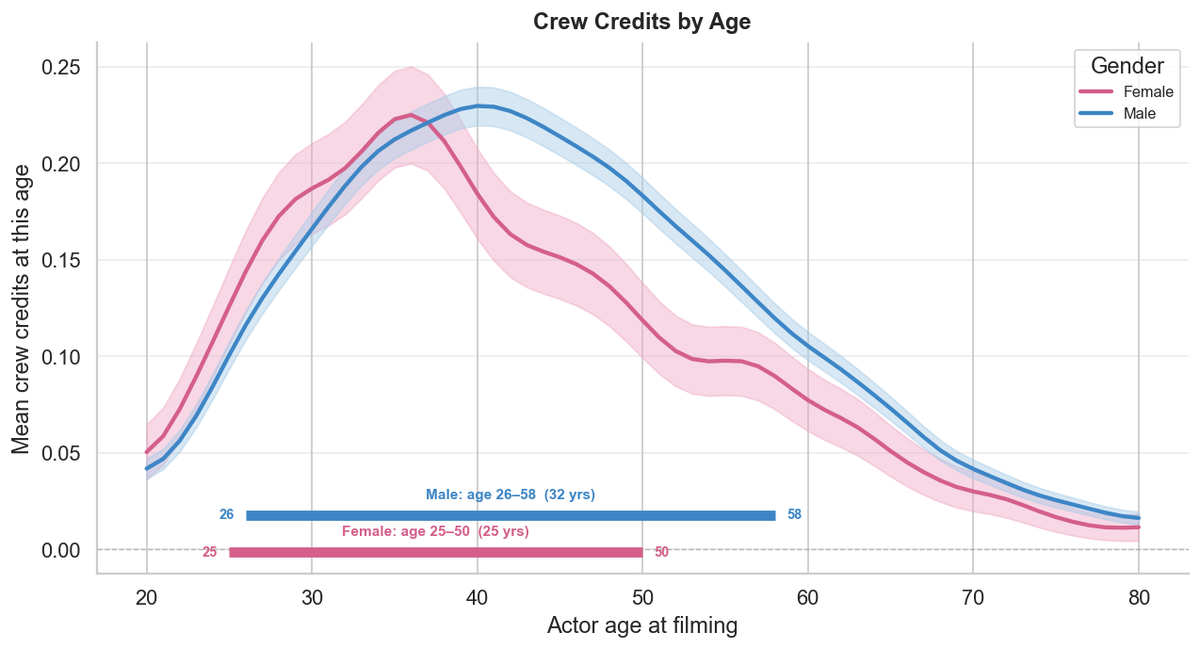
I started off with a dataset of every popular actor and actress with credits in predominantly English-speaking films since 1970. Bias against older actresses can be hard to notice, partially because some stars do continue making movies into their 70s, and those tend to be the ones we remember–not all the up-and-coming actresses from 20 years ago who haven’t made any movies since. So I looked at each person’s career from the perspective of how productive they were at each age from 20-80.
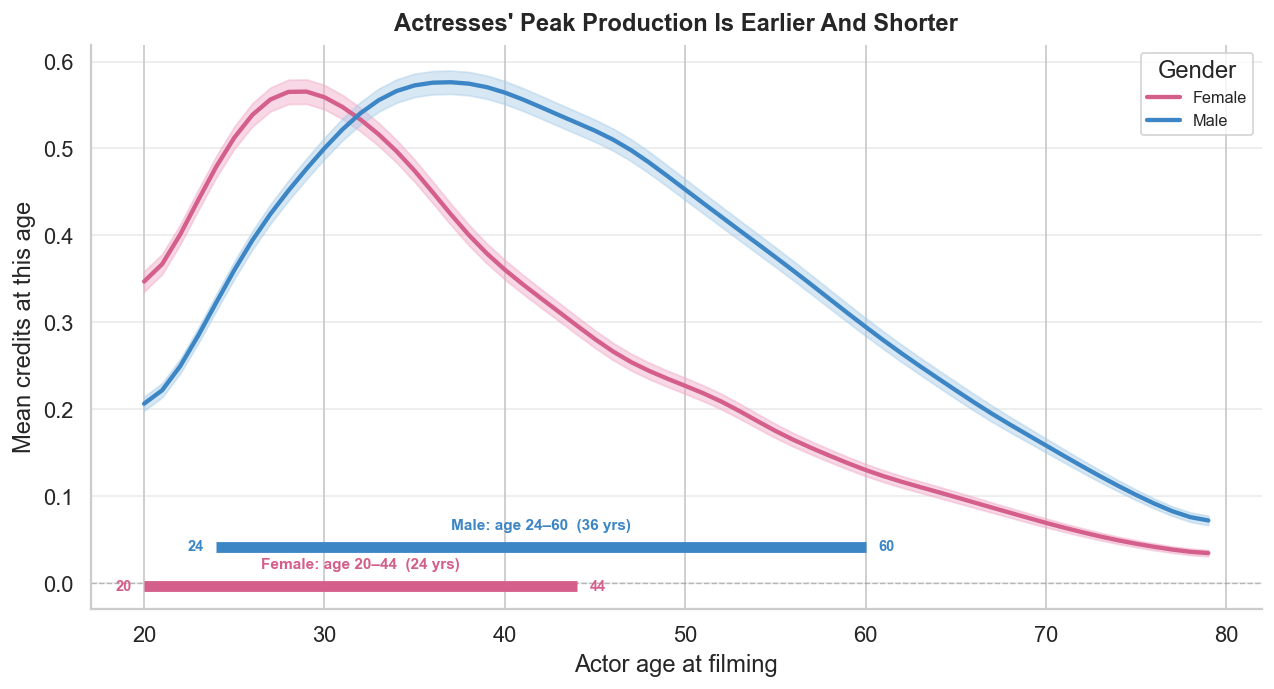
The difference in credits is obvious. Actresses reach their peak production earlier, but they also have a 50 percent shorter period of peak production (denoted by the horizontal bars towards the bottom of the chart). Women reach the halfway point of their careers around age 30, while men don’t reach theirs until 40, a staggering decade of difference. Men do enter the industry a little bit later on average than women, but only by five years (women at 23, men at 28)--explaining half of the difference in peak timing, albeit none of the difference in how long the peaks extend for.
While there are modern examples of older female stars defying this trend, they tend to be few and far-between. There hasn’t been much substantive progress over the last few decades. In the 1990s, actors over 40 received about 42 percent more roles than actresses over 40; in the 2010s, it was 30 percent. Halfway through the 2020s, it’s 33 percent more roles for men than women.
The underrepresentation of older actresses is obvious in nearly every metric. For women, increasing age is correlated with fewer movies and fewer top-billed movies. For men, it is the opposite2: as they age, they tend to get more credits and better roles under their belts. Women not only receive fewer parts overall, they also receive significantly fewer top-billed parts. When they do receive credits, they tend to be for smaller, lower-budgeted movies.
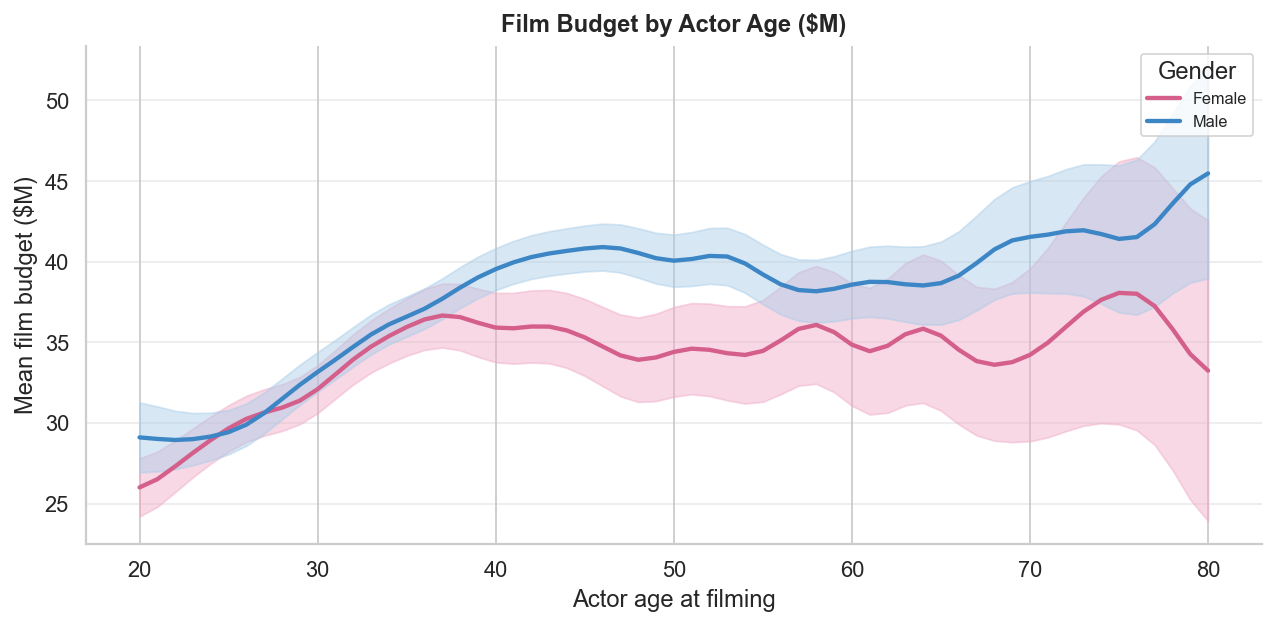
Women are also paid less than men for the roles they do get. That’s partly reflected in the budget chart above: movies with smaller budgets will tend to pay less, and older women tend to disproportionately star in movies with smaller budgets. Some academics have argued that this could be “consumer discrimination;” in other words, that movie-goers specifically choose to go to movies (mostly action movies) with older male stars, while eschewing older female-focused films. This rationale effectively gets Hollywood producers off the hook (legally, at least) by allowing them to claim that they are just following the market, instead of being the cause of the prejudice against older women.
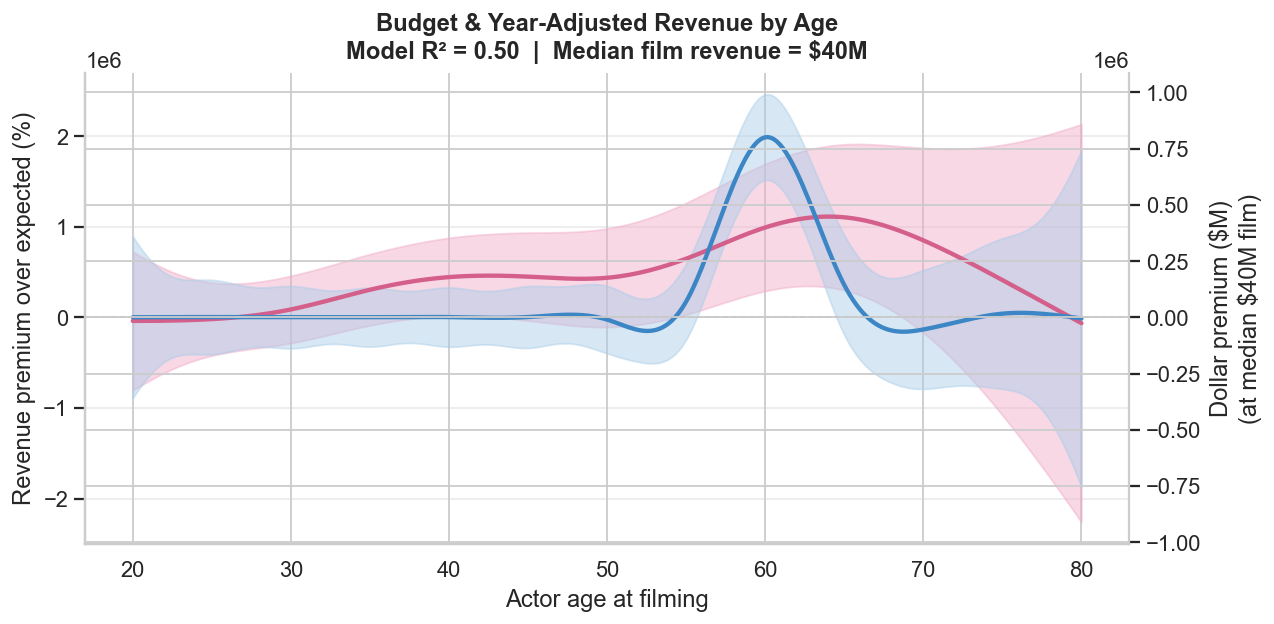
The stats don’t bear this out. Correcting for budget and year of release3 (bigger budget, more recent films tended to make more money), movies with female stars tend to have higher or equal revenue, not lower. If anything, audiences seem to prefer watching movies with older women.
But I think there’s an even stronger data source that points to the bias against older women being a cultural problem. Not only do actresses’ careers fall apart after 40, female crew members see nearly the same decline, despite not (usually) stepping foot in front of the camera4.
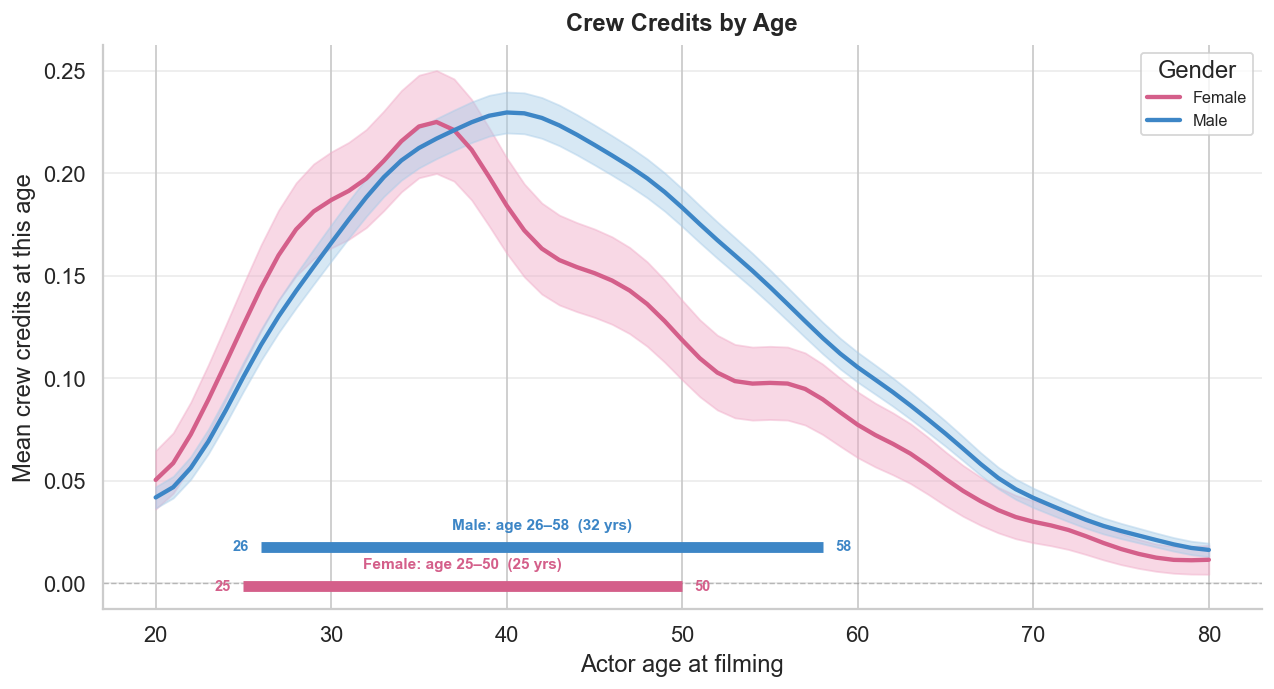
It is, of course, worth noting just how rare women are in these various departments to begin with. Across writing, camerawork, directing, and sound, men make up more than 85 percent of all the tracked credits. But even for the few women who manage to make their careers in these crew jobs, a huge productivity gap opens up after 40, when women receive fully 39 percent less work than men–similar to the bias against older actresses.
You might be able to argue that moviegoers care about how actresses look on screen, but I don’t buy that they’re discriminating5 against female camera operators, or writers, or composers–yet each crew category shows the same post-40 dropoff. Meanwhile, men in each of these disparate fields tend to show continuing productivity even into their 50s.
All of these results suggest that men and women in Hollywood see their careers change in very different ways as they get older. Men peak and then plateau from around 30-50, with some stars seeing increasing credits, higher budgets, and more top-billed roles as they age. Women's careers, by contrast, tend to spike at 30 and then drop off rapidly, with only the most productive stars able to sustain consistent star roles after that point. This goes for both cast and crew, suggesting the underlying problem in Hollywood has nothing to do with consumer preferences and may instead trace back to misogyny.
There’s another element beyond just how old actors are that’s changing the equation–and that’s how old actors look. In the next installment, we’ll take a look at how much perceived aging impacts the ability of actresses to keep getting roles into their later years.
1 This topic has been investigated and written about before more than a few times, but to varying depths. I have a huge dataset from the Movie Database gathered for a previous research project, with tons of context data added, so I thought it was worth looking into as well.
2 Both correlations are weak (around r=0.1), but statistically significant (p<.00001).
3 I used a few different kinds of models here, but the one depicted in the chart is a generalized additive model that explained about 50 percent of the variance. Bear in mind that the averages for revenue are highly skewed here by extreme outliers that make hundreds of millions or billions of dollars in revenue, and that we’re looking at a dataset of at least somewhat popular actors to begin with (popularity score > 1, in the Movie Database terms).
4 Actors, especially older actors, frequently tend to receive cast credits as writers, producers, etc. I excluded actors and actresses (defined as people with primarily cast credits) from the crew analysis to avoid contamination between the two.
5 There are, of course, other explanations that skeptics could advance, such as women choosing to leave careers earlier to raise families instead. However, I think this is unlikely to explain much of the decline, especially given the timing of the dropoff in production. Female cast and crew see their largest decrease in their late 30s, which is usually after most people choose to have children and after most parents choose to leave the workforce.