For Hollywood Actresses, Looking Younger Pays Off


Every year they can shave from their appearance equates to millions of dollars in career earnings.
I recently wrote about the blatant bias against aging female stars in Hollywood. I found that women in Hollywood experienced their peak productivity earlier and for a shorter period of time than their male colleagues. They also worked in lower-budget movies than men as they got older, despite performing about the same at the box office. Moreover, this bias extended to crew members as well, suggesting it had nothing to do with audience preferences.
In short: Women over 40 have it rough in Hollywood. (I know, revelatory.) But they also have a weapon at their disposal to fight back: they can (and do) look younger than they are. Using the apparent age of movie stars rather than their chronological age, we can see that women over 40 stay productive at the box office by seeming youthful.
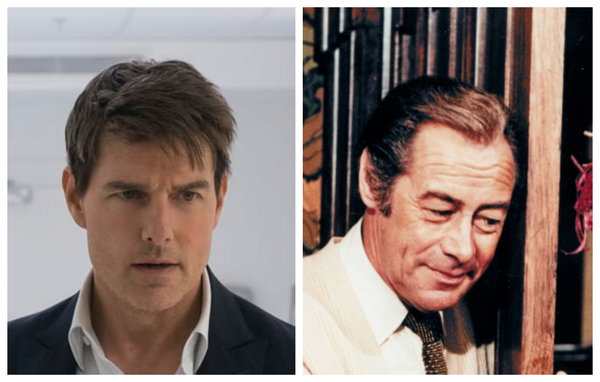
Let’s start by unwinding how I can measure apparent age. First, the data: The Movie Database provides posters and promotional images from each movie that contain the actors’ faces. I used an algorithm called InsightFace to estimate each person’s age from these photographs, taking care to make sure the algorithm could confidently identify the correct person in each image. InsightFace works by looking at thousands of pictures of real people with known ages and learning how to recognize, from a face, how old the person is. Here are some examples of it in action on my real data (check the labels for the specific actors from each poster):

Overall, this algorithm is quite accurate and it can typically estimate a regular person’s age to within seven1 years. (By “regular person” I mean as distinct from Hollywood actors, who as we will see, are a bit different.) That accuracy is about on par with how close humans get when we guess each others’ age, which tends to fall between about 5-10 years off depending on the age, gender, race, and expression of the judged photograph (smiling faces tend to be judged as younger). As you can see above, it’s far from perfect for any given estimate, but averaging over 20,000 images and thousands of actors helps reduce the impact of errors.
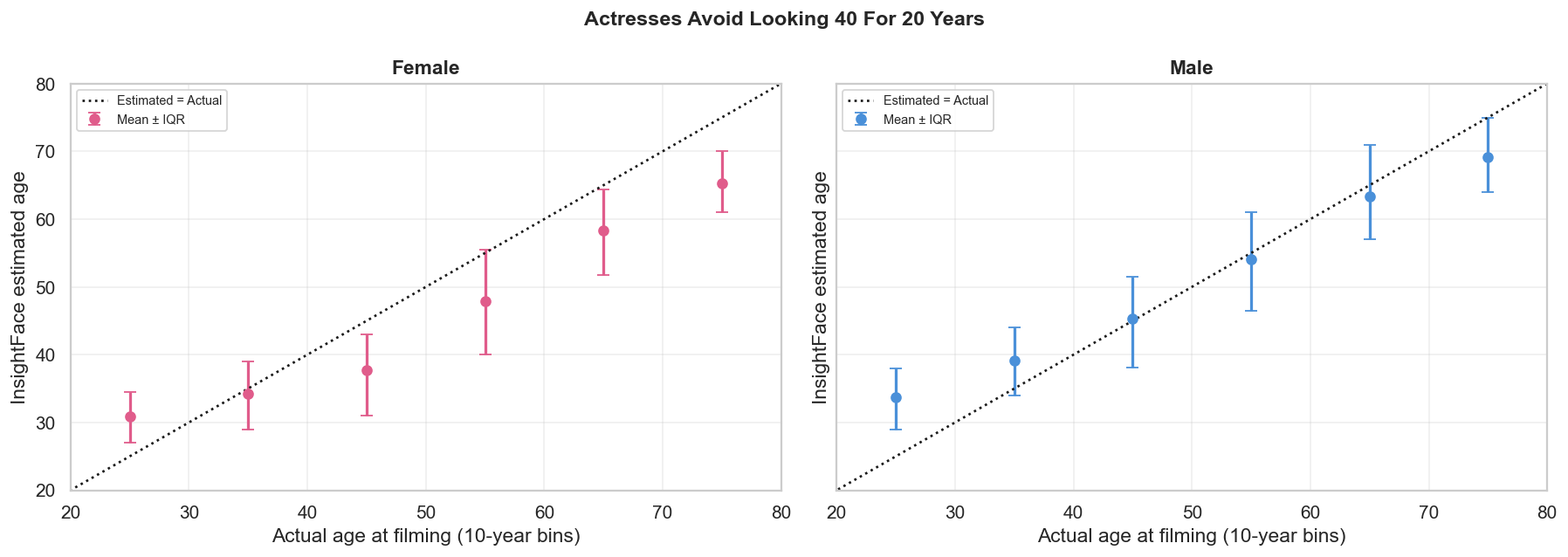
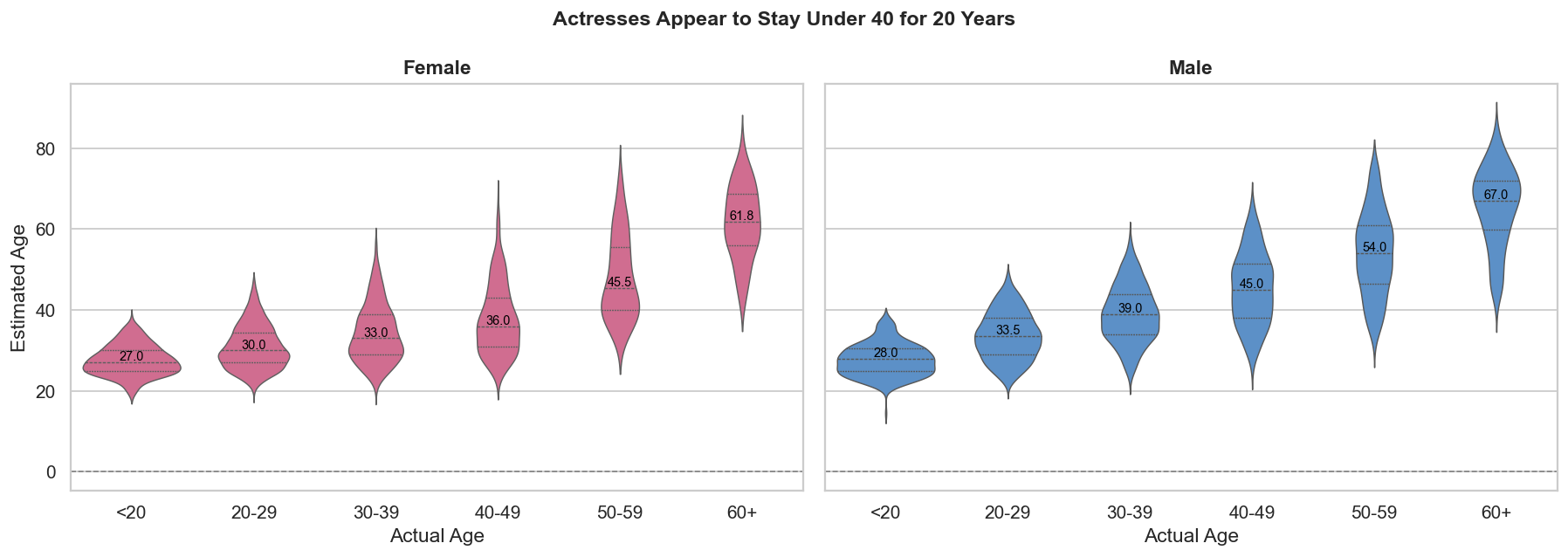
With age estimates in hand, we can take a look at how our Hollywood sample ages relative to us normies. These charts show two depictions of the average apparent age of different stars at different chronological ages. In each chart, people who age normally–that is, they look as old as they are–would appear approximately on the diagonal line. Slower aging is lower than the diagonal, while faster aging would be above the diagonal.
Actresses, unsurprisingly, appear to age much more slowly. The median starlet doesn’t look like they’ve hit 40 until they’re almost 50. For women, the difference between their apparent and real age is highest in the age range where you’d expect the most pressure on actresses to appear young: from about 30-50. When they are in their 40s, most look like they are 30 or less, and some even sustain that into their 50s. Meanwhile, actors show an apparent age similar to their actual age. In their 20s, they look 34; in their 30s, they look 30; in their 40s, they look 45.
(There’s a notable bias for both actors and actresses in their 20s to appear a little bit OLDER than they are. I’m not sure what explains it, but the difference between a 23-year-old and a 29- or 30-year-old in terms of how they look is not very significant.)
The abundance of younger-looking women is certainly suggestive that there’s a pressure to look young, especially around 40. When we combine that with the testimony of dozens of prominent actresses, there isn’t much doubt that there’s a bias. But we can go further; we can actually connect how young an actor looks to their future productivity from that point. My hypothesis here is that the experience of those many over-40 actresses will be born out in the data: if they look older than 40, they will be less likely to appear in future movies, and tend to star in smaller-budget, less-popular films even when they are cast.
The first approach I took to testing this hypothesis was to divide our actors and actresses up into three cohorts of career production based on the average budgets of their movies: high, medium, and low. The groups also correspond with the total number of movies they’ve appeared in and the popularity of those movies (as measured by TMDb vote counts), so the actors who have the highest average budgets also show up in more and higher-profile movies, too. If apparent age has an impact on productivity, we should see these three groups diverge right around the 30-50 range when women sustain their youth. The highest productivity group should look significantly younger–and they do (vertical lines are bootstrapped 95 percent confidence intervals).
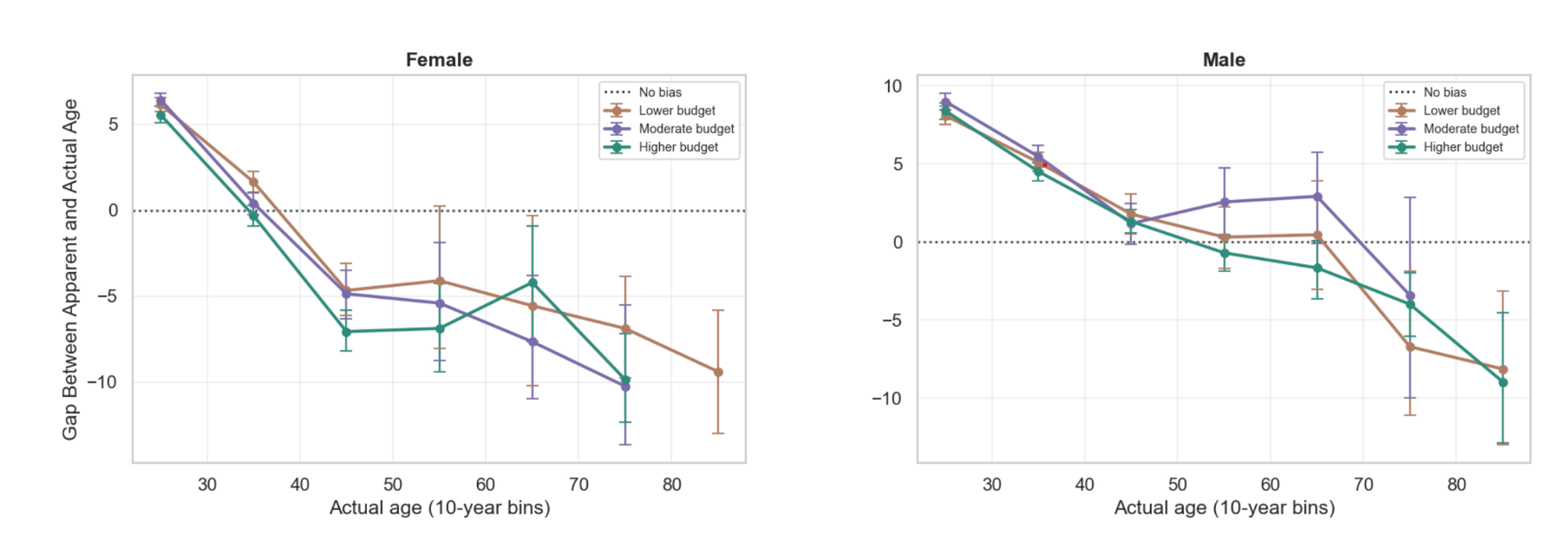
While the correlation isn’t perfect, you can see that the most productive actresses have a significantly (2-4 years) lower estimated age, especially in that same band we identified above: 30-50. Data thins out substantially from 60 years on, in part because there are simply so few parts for older women and thus less data to go on.
Men show a similar qualitative pattern in that the highest productivity actors also look the youngest, but moderate and lower productivity groups bounce around each other, and the differences are almost never significant. In other words, high productivity male stars can look young, old, or exactly their age; their appearance is less correlated with their average production budgets.
We can take this one step further and actually estimate how much each year of apparent age takes off of an actress’ earnings. TMDb doesn’t provide actors’ actual salaries, but Vanity Fair has estimated that the top three roles in a movie command, on average, about nine percent of its total budget–and TMDb does have data on theatrical budgets. So, if we assume that these relatively popular stars make about three percent of the total budget2, we can make an estimate of how much actresses lose by looking a year older.
Estimating this is a thorny statistical problem that’s deeply confounded by survivorship bias and I won’t dive too deeply into the details in the main text. Suffice it to say that I used a host of different methods to estimate the impact of looking younger on an actor’s earnings and popularity. Depending on the statistical model3 you use, estimated age can actually come out as a stronger predictor of an actor’s future performance (in terms of budget and popularity) than their actual age is. But the output of these models is that female Hollywood stars who look younger in their 30s-50s can earn about 10 percent more per year of estimated age that they take off their chronological age4. Their male colleagues, by contrast, are more or less unaffected by apparent age, showing at best a one percent increase in earnings per year.
These margins add up, especially multiplied over a full career. The model predicts that a woman who manages to consistently look five years younger than she actually is from chronological ages 20-50 should make $12.5M more over their career than someone who looks as old as their passport.
Let’s put this all together. Women in Hollywood succeed in looking much younger than they actually are–especially around 40. (Men mainly look similar to the general population in each age group.) Actresses who look younger benefit financially. For each year they can shave off their true age, they can make about $2.5 million more over their careers. It’s no wonder that they go to great lengths to preserve their appearances; wouldn’t you do the same for a few million dollars?
1 I’m referring here to the median absolute error. The mean absolute error is higher, but also more sensitive to outliers. Outliers can be tricky here, because actors sometimes appear in roles where they are specifically trying to appear older or younger than they are, whether through makeup, CGI, or good old fashioned camerawork. To reduce their influence, I removed any data points where a person looked 20 or more years older or younger than their actual age. The results were, however, stable when I relaxed and changed this cutoff. Otherwise, I used the same sample filtering procedure as in the previous post.
2 It’s much more complicated than this, of course, for about a hundred different reasons. To start off with, the lead role tends to make significantly more than the second- and third-billed stars. Men are much more likely to occupy this lead role even when the two characters have roughly equal screen time, and producers elect to pay men more even when all else is equal. So, the rule of thumb that three percent of the total budget is going to each of the top three is undoubtedly wrong at least some of the time, yet the broader point remains–women star in much smaller, less financially-supported movies as they get older, both in terms of chronological and apparent age. That very likely equates to lower salaries.
3 I tried a number of different models here: Poisson and Negative Binomial regression, Random Forests, Generalized Additive Models and others. I used variables like release year of each movie, gender of the actor, as well as chronological and apparent age. All supported the idea that estimated age matters in the expected direction: looking older equates to lower budget, less popular movies. The results I’m discussing here are from the Random Forest model with the four variables listed above, and represent the marginal effect of adding one year to each actor’s predicted total budget of the films they’re in.
4 Again, I’m simplifying what is (and has to be) a nonlinear relationship. Women who look 20 years younger don’t earn 200% more. But the effect at the extremes is hard to estimate because the data thins out–it’s pretty much impossible, with our current technology, to look like you’re 25 when you’re actually 50.