Trump’s DOJ Is Pursuing Fewer Non-Immigration Criminal Charges

The Department of Justice is the federal government’s main law enforcement apparatus, and it has shed thousands of personnel since the beginning of Trump’s second term. There are fewer ATF (Alcohol, Tobacco, and Firearms) employees; fewer agents at the FBI; and notably, for our purposes, a widespread exodus is under way from the States’ Attorneys offices that prosecute federal crimes. Among those that remain, DOJ leadership has dedicated a huge portion of their time to immigration enforcement.
With so many lawyers leaving and the ones that are left prioritizing immigration charges, it stands to reason that the federal government has less time available to pursue the traditional priorities of the States’ Attorneys offices: serious crimes. And that’s exactly what we see in the data: non-immigration charges are down significantly, and the Trump administration’s DOJ is losing more cases than any time in the last two decades.
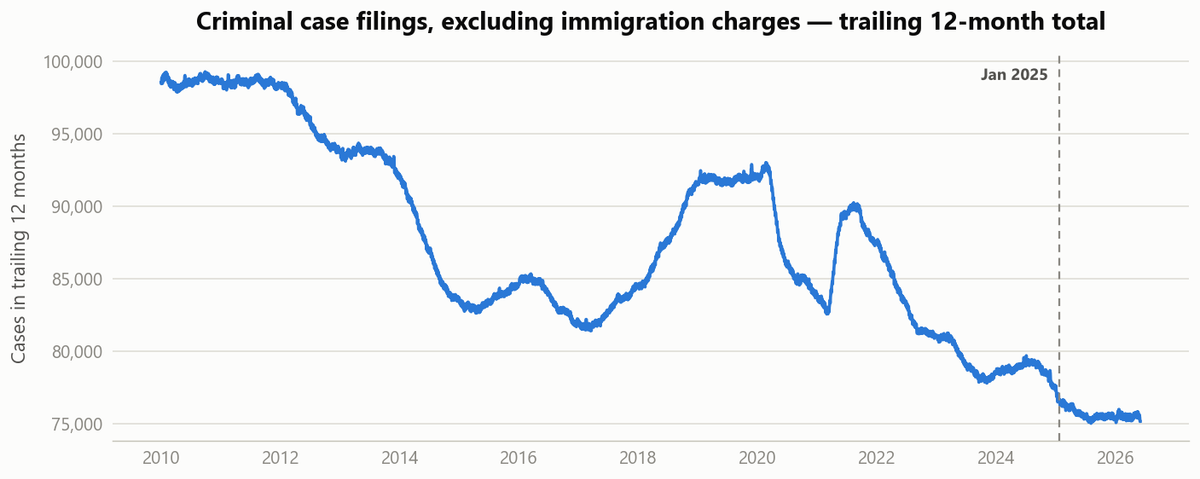
There's been an overall downward trend in criminal charges over the last three decades, both in federal and state courts, but the first full year of Trump’s administration stands out. Trump’s administration is pursuing about six percent fewer non-immigration related criminal charges than at any time we have national caseload data from the Department of Justice1,2.
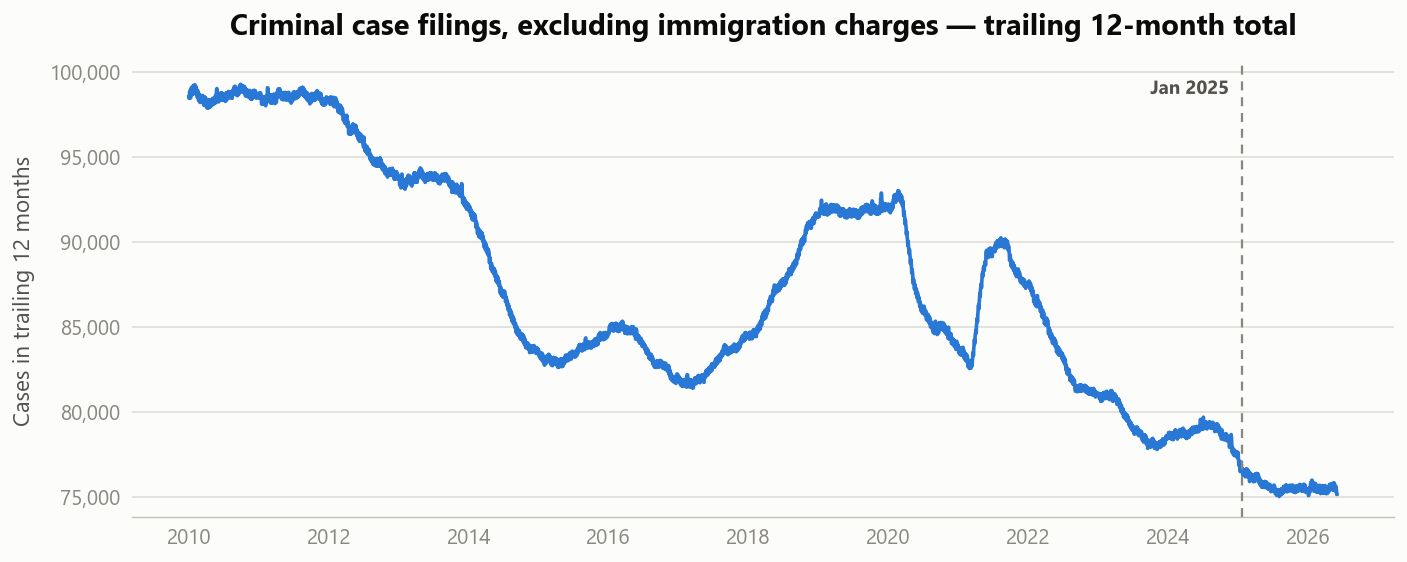
There is additional, independent evidence to support this idea as well. In DOJ’s annual reports, there were fewer non-immigration related cases in Fiscal Year 2025 relative to 2024. The number of hours attorneys worked also dropped quite significantly, corresponding to the major loss in staff. The federal court system produces its own set of statistics showing a large decrease in the fraction and number of non-immigration related cases. So, this decline isn’t limited to one particular, potentially-flawed dataset.
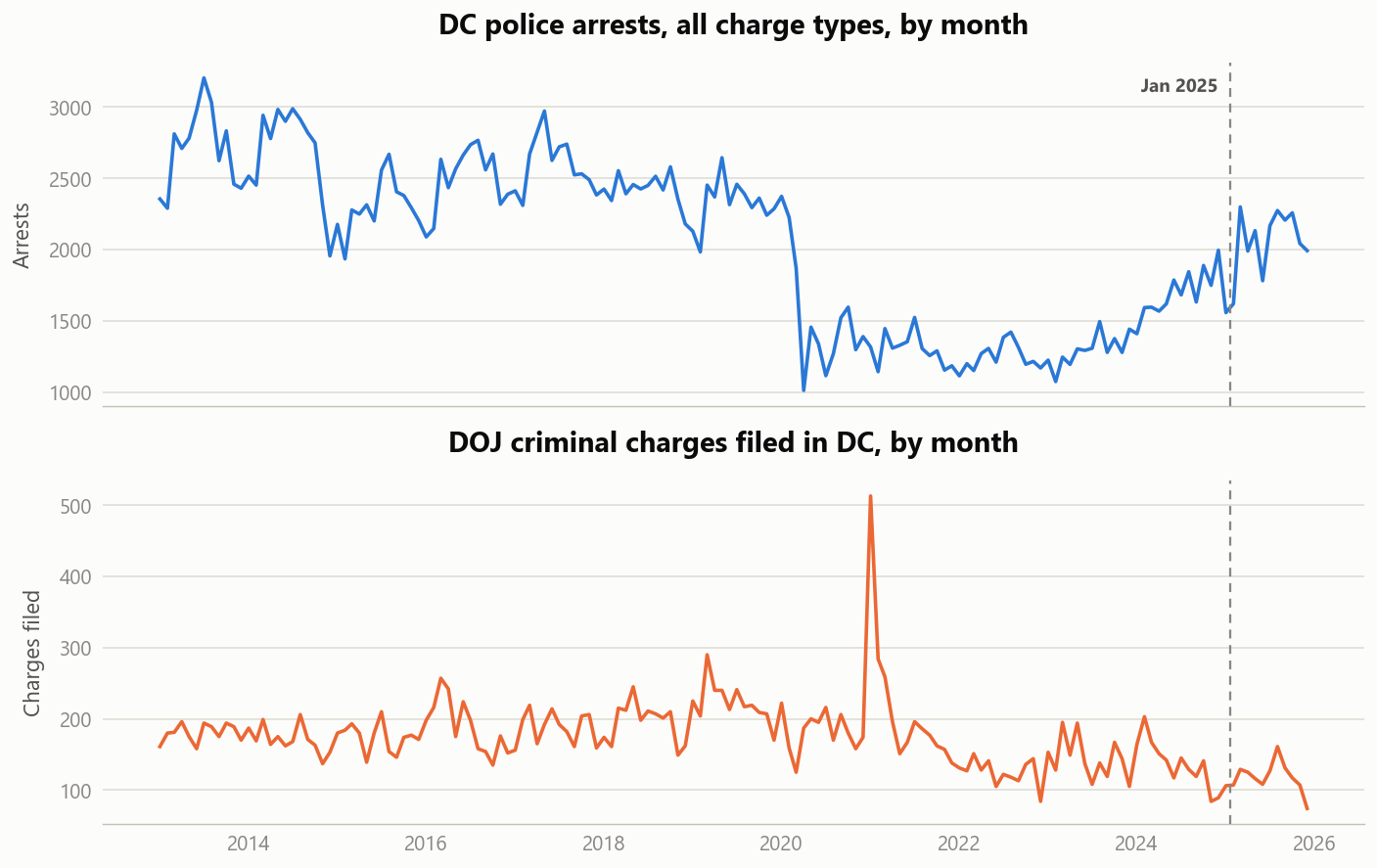
While the overall decline in more serious charges is modest, some particular districts show major drop-offs. Washington, DC is one example. DC is also notable for a huge loss in staff positions since the beginning of the Trump administration, shedding about a third of the office from 2024 to 2025. DC is unique in that the District Attorney’s office there prosecutes what would be state-level crimes in other jurisdictions, which provides us with a way to actually check against the number of arrests that might turn into prosecutions. In examining the ratio of arrests to charges filed by the DC office, we see a major decrease since Trump and his assistant District Attorney, Jeannine Pirro, took over. Arrests are up; new criminal cases are down to their lowest levels since at least 2013.
What’s happening to these extra arrests? It looks like the DOJ is declining to prosecute many more of them. From fraud to drug charges to sex crimes, the rate of guilty results for these charges in DC is down, and the rate of declined prosecutions (when the DOJ chooses not to pursue a case) is up. Given the privacy around the exact circumstances of each arrest/charge, we can’t necessarily tell if those declined charges would have yielded guilty verdicts or not; perhaps there genuinely wasn’t enough evidence to convict. Some were no doubt trumped-up instances of false violence against police officers, but others--like possession of child pornographic materials--seem completely unrelated to the crackdown. But given Pirro’s aggressive approach to charging some minor infractions, it’s surprising she wouldn’t want to go after potentially serious crimes in the district.
The drop-off in overall case numbers coincides with a significant decline in the DOJ’s ability to win cases as well (both civil and criminal). The government’s win rate (or times a case ended with a ruling favorable for the government) has dropped by about 10 percent since the Trump administration started. On further examination, however, the vast majority of the drop in win rate comes from habeas corpus petitions. These arise often from immigration cases where the government detains the undocumented person without a hearing, a practice many courts have repeatedly ruled is illegal. So the government continues to lose these cases, but also continues to harm immigrants by holding them in detention; the win rate probably matters less to DOJ than the ability to, even temporarily, ruin peoples’ lives.
Outside of DC, it can be hard to check the records in this dataset against other available data, since so much of the case-by-case information is redacted. But one area where there is clear evidence of at best inaccuracy (and at worst distortion) in the records is in terms of “no-bills.” No-bills occur when the government presents a case to indict someone on criminal charges, but the grand jury chooses not to indict. Before the Trump administration, these outcomes were astoundingly rare: less than 0.01% of all grand jury proceedings yielded a no-bill. This rarity gave rise to the familiar saying that “a grand jury would indict a ham sandwich.”
That was before the Trump administration started trying to indict ham sandwiches though. (Or people with about as much criminal culpability as ham sandwiches.) Since Trump's second term began, there have been more than a dozen known no-bills, including notable cases like the DC Sandwich Guy3, who threw a sub at a police officer during the crackdown. Those no-bill charges are not reflected in the data, however; in the available records, no-bills are actually down from prior years. Local DA offices, such as DC4, seem to be recording no-bills in a different way in the system, perhaps to avoid the embarrassment of huge increases in no-bill outcomes that we should otherwise be seeing. (One of the case disposition categories that is increasing in frequency is labeled “office error/opened in error.” The use of this label has increased by about 40 percent in the last six months.)
Poring over these reams of DOJ records brings another angle to the Trump administration’s anti-immigrant priorities. Whatever you think about their odious persecution of immigrants, you should also be concerned about the external cost of that policy. Nothing in government is free; if you put greater resources into harming immigrants, those resources have to come from somewhere else.
In this case, DOJ attorneys have a finite amount of hours in the day to spend on work. Redirecting them to spend those hours on criminally prosecuting immigrants means that they have less hours to spend on pursuing other prosecutions for things like violent and drug crime. There’s no free lunch.
And the problem is even worse than that for Trump’s DOJ, because they’re not simply redirecting resources from one priority to another. They’re actually down about 10 percent of their lawyers, meaning that they have significantly less time overall. The cost of immigration enforcement isn’t just the persecution of immigrants; it’s that our federal law enforcement has substantially less time to undertake more serious cases as well.
1 This data is a snapshot in time with a lot of redacted records. One cause of redaction is if a case is still in progress or recently initiated. If you pull previous editions of the data, you’ll also see a small decrease in recent cases, which I believe corresponds to these redactions of still-in-progress cases. However, the dropoff that we’re seeing now in the second Trump administration exceeds these previous (artifactual) declines.
2 This includes title 08 cases, but I also observed an increase in title 50 cases, which are related to trespassing on military bases. Apparently the increase in title 50 cases comes from a novel legal strategy some border state District Attorneys are pursuing whereby they are charging undocumented immigrants with trespassing on military land when they are intercepted in the border states.
3 Tragically, it was not a ham sandwich.
4 There are at least six known no-bills in DC alone, but not a single recorded no-bill in the data.