Video Games Are Becoming Art


Roger Ebert once famously claimed that video games can never be art. Many game designers (and players) may beg to differ, but I think the early days of video games certainly don’t qualify as art. Pong and Space Invaders may be fun, but they lack characters, plot, or almost any narrative. Even into the 90s and early 2000s, video games were primarily judged (and rightly so) by how fun they were to play, not the emotional resonance they provoked in the gamer.
But the last 15 years have seen a pronounced evolution in how both players and critics consume video games. The medium has gone from risible storytelling, badly adapted into other forms, to a font of ideas inspiring prestige TV like The Last of Us and best-selling novels. In tandem with this change, video game reviewers have focused their attention more and more on the story and narrative of the games they play as well as the emotional reaction those games produce.
I gathered data from Metacritic, a review collection website from 2011-2026 to look into this topic. Metacritic contains feedback from both users and critics1 alongside their overall score, normalized to a 0-100 scale. Because it goes back so far and covers so many games (tens of thousands), it’s a good source to test how gamers have changed the way they evaluate the medium.
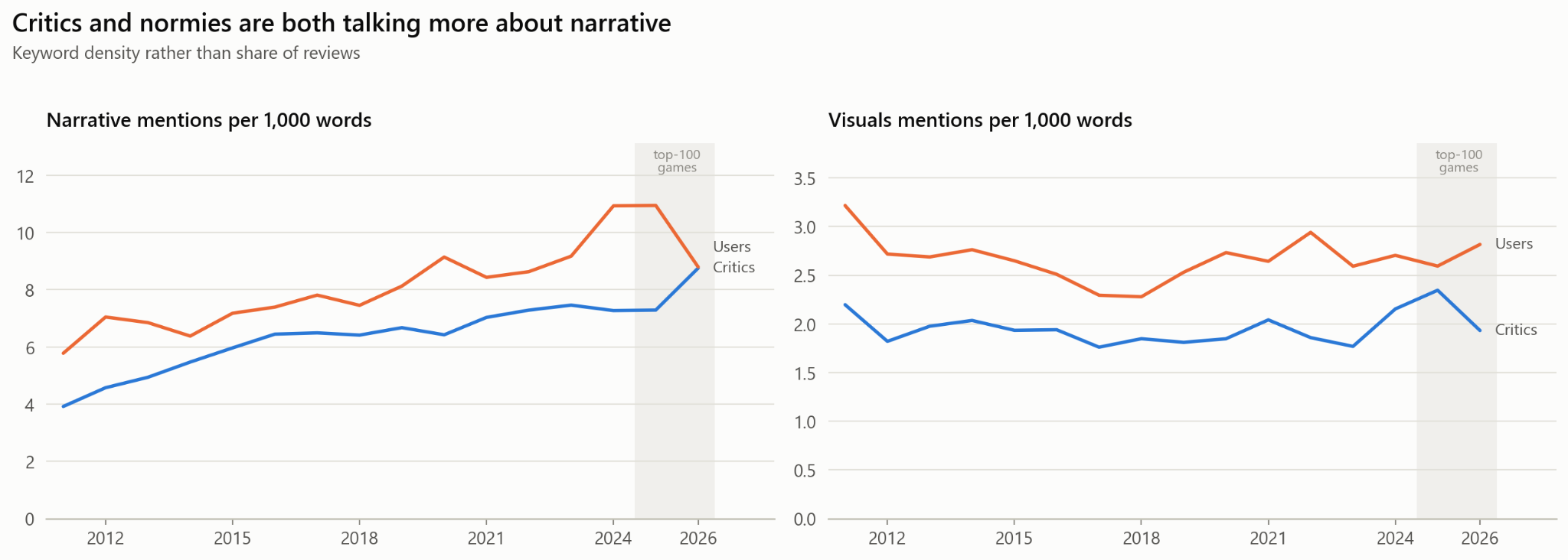
Just as movies can be broken down into different facets (cinematography, music, acting, editing, etc.) so too can games. Traditionally, gamers have often focused on lifelike graphics and value proposition (how much gameplay is available for a given cost). That's not the case any more: mentions of the visual aspects of a game have stayed completely flat since the early 2010s, while discussing the narrative has spiked considerably (approximately twofold among both types of reviewers). Over the last few years, narrative mentions are about four times more common than visual critiques.
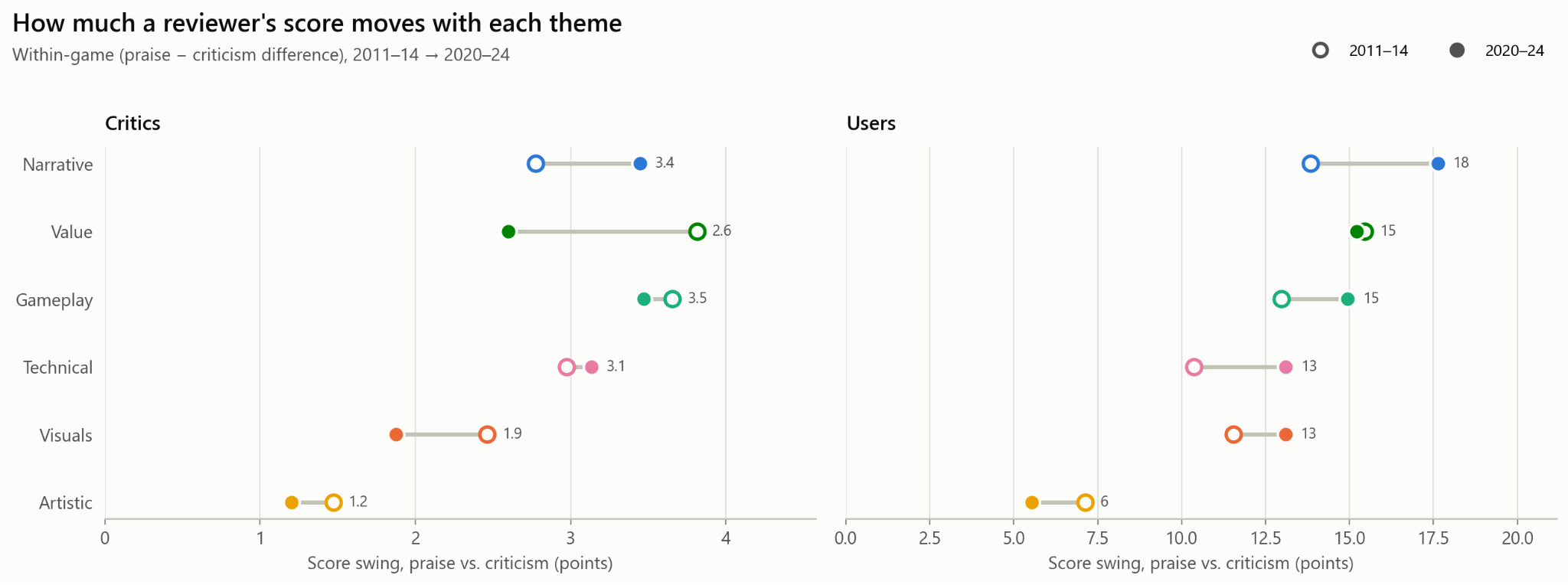
Not only are gamers more focused on describing the plot in their reviews; they also seem to factor it into their overall score for a game to a greater degree. Gamers who praised2 a game’s story tended to score the work 14 points higher than gamers who disliked it in 2011-2014; by 2021-2024, that gap grows to 18 points, a 30 percent increase. This gap between “good story” and “bad story” games is actually larger even than the one for gameplay itself. The same general pattern goes for critics. Both pools actually seem to weigh story as a larger factor in a game’s quality than almost anything else these days, which wasn’t true 15 years ago.
Obviously art is not defined by narrative alone, and famously there is no single definition for the word that all agree on. But one indisputable characteristic of art is that it arouses a range of thoughts and emotions in viewers, and that property is certainly lacking in early (popular) video games, a fact which provoked some of Ebert’s ire. Mario and his derivatives are many things, including fun, but thought- or emotion-provoking they usually are not. Here, too, though, we see reviewers rounding into describing games in ways they didn’t use to.
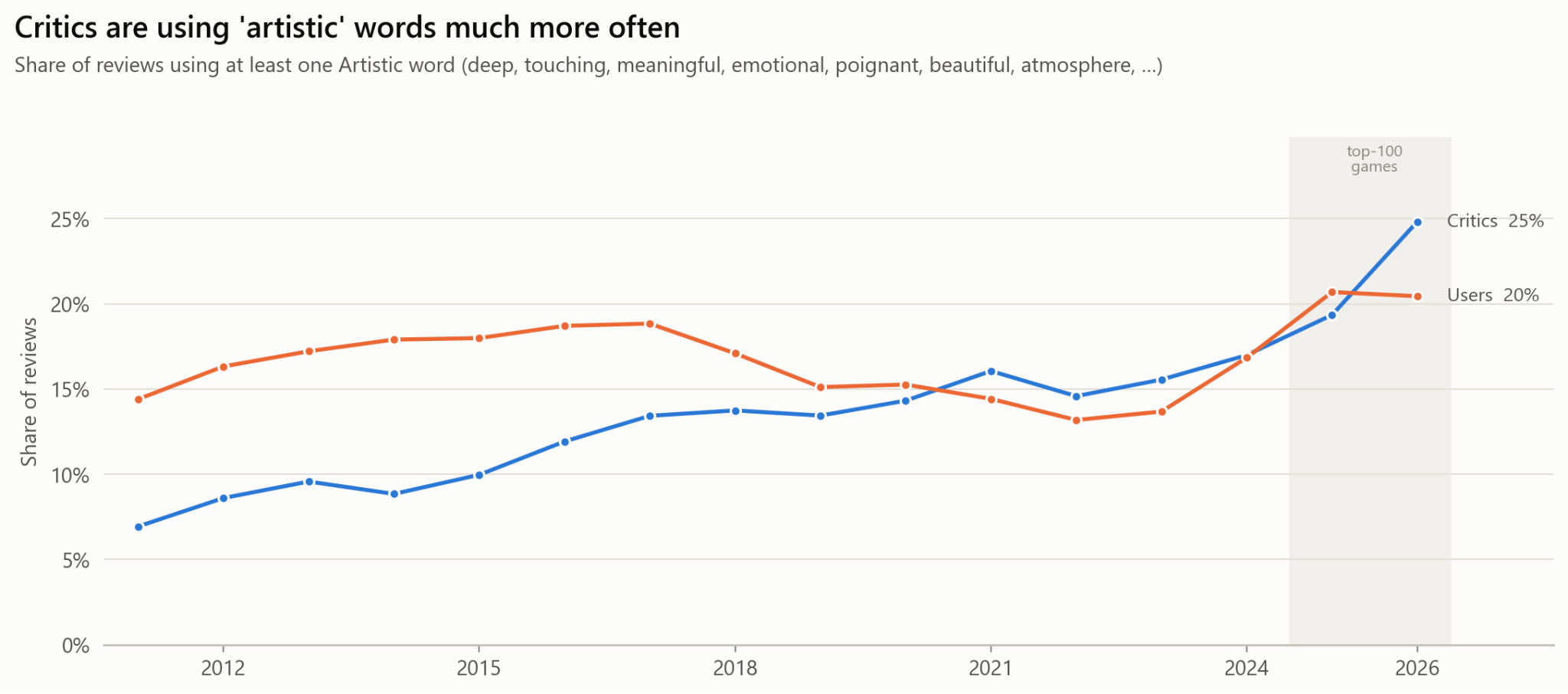
Critics are now much more likely to use terms like “emotional,” “deep,” or “moving,” alongside other obvious art-associated words like “meaningful” and “artistic” itself. (The gamers’ trend line is a little more mixed.) Use of those terms tends to be alongside higher-scoring games, as one might guess. “Bittersweet” comes with two extra points on the 100-point scale; “made me cry” is worth five. Reviewers seem to be much more concerned with how a game makes them feel or how much it makes them think–hallmarks, at least in my mind, of an artistic form.
Hit games of the last decade like The Last of Us and Clair Obscur: Expedition 33 are known as much or more for the unique, beautiful, and at times heart-wrenching storytelling than they are the gameplay alone. Both created interesting dilemmas with their use (and withdrawal) of choice at pivotal moments in the narrative–a unique feature of video games that most other media don’t and can’t possess. Both featured incredible human performances from real, live actors, which turned into the animations and voices used in the games themselves. If Pedro Pascal’s performance of Joel in The Last of Us TV show was art, then surely Troy Baker’s performance of the same role in the game was, too.
And lest you think this is some general trend towards storytelling driven by world events or generational shifts, I examined the same questions among movie reviews (also sourced from Metacritic). Movie users and critics do not display the same increasing focus on narrative. From 2011-2014 to 2021-2024, story-focused verbiage in film reviews increased only about 10 percent, compared to the 40-50 percent rise among gamers.
In fact, interestingly, professional game reviewers tend to mention the quality of a game’s plot more often (29 percent) than their cinema critic counterparts talk about movie plots (20 percent). Take that, Ebert. Who’s art now?
In fairness, the title of Ebert’s essay was misleading. He actually wrote:
Let me just say that no video gamer now living will survive long enough to experience the medium as an art form.
I think he’s wrong by a few decades. At least some games are art right now, and more are getting recognized as such each year. The artistic aspects of a game are an accepted and highly-valued part of how people appraise games, just as with other types of art. The reality is that most media contains a mixture of different forms and functions within it. Not all movies are art (sorry, The Expendables 4); not all paintings are art (sorry, banal landscapes at the dentist’s office); not all video games are art either. But some of each qualify, and video games are beginning to take their place at the table alongside other forms of media.
1 Here are a few notes about data limitations. One, critics’ reviews are limited to snippets, not full text; that served my purposes, since a critic's mention of a story in the snippet probably indicates that it's a more prominent part of the game. Two, I was only about to get data on the top 100 games for 2025-2026 for technical reasons, but I verified that all the trends hold if limited to the top 100 games in every other year as well. Last, no critic names are available, only outlets, and users are only identifiable with usernames.
2 I used VADER for sentiment analysis here. VADER was designed for social media texts, so it’s not a perfect fit, but Metacritic reviews are usually short and punchy, and I have so many that occasional misfires on sentiment judgments will tend to wash out.